
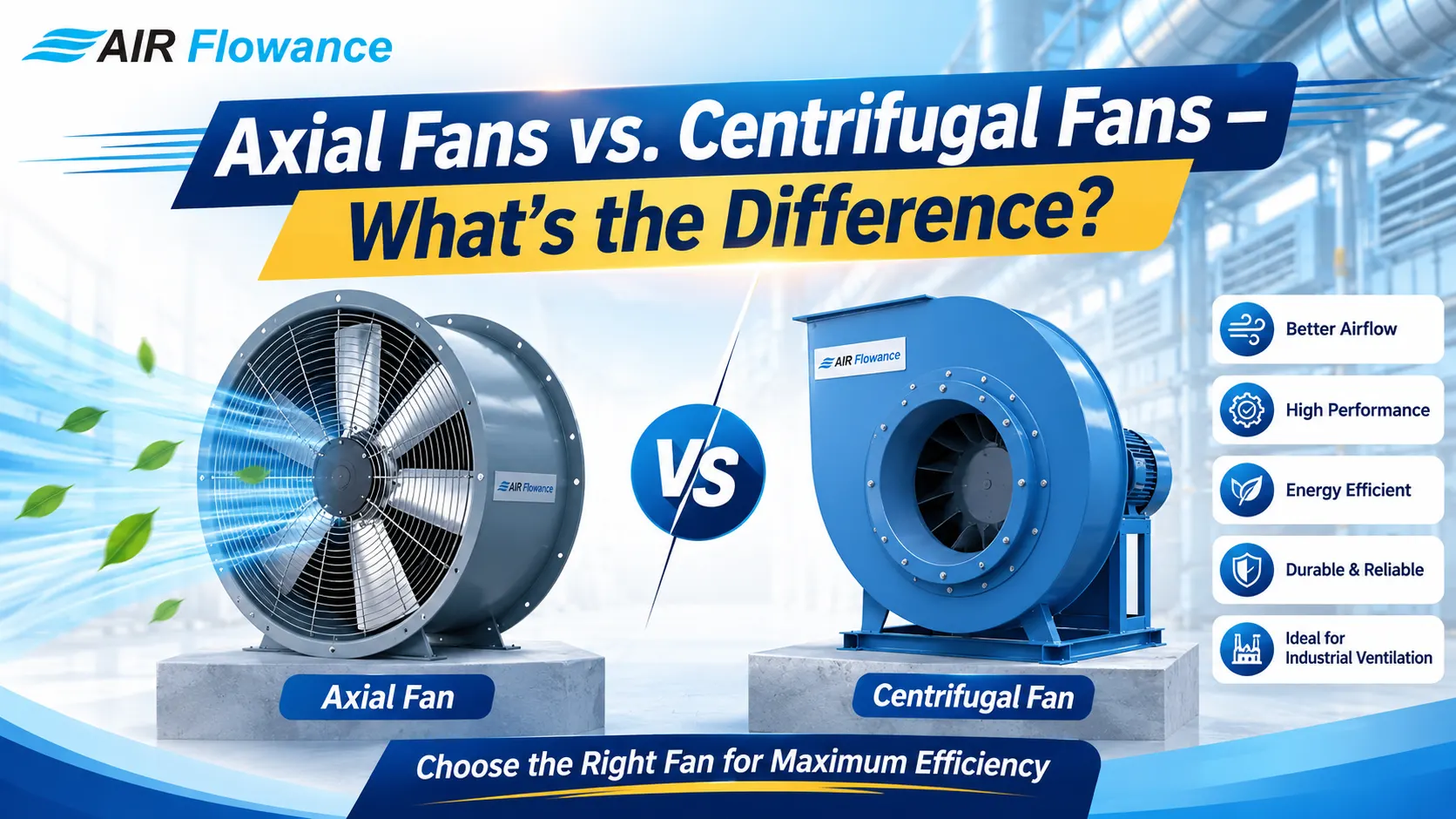
Among the most commonly used fans are axial fans and centrifugal fan systems. While both are designed to move air, they operate differently and are suited for different applications. Understanding the axial fans vs. centrifugal fans comparison helps businesses choose the right equipment for their ventilation requirements. At Air Flowance System, we offer high-performance industrial fans that deliver reliable airflow, energy efficiency, and long-lasting performance for a wide range of industries.
What is a Centrifugal Fan?
A centrifugal fan is a mechanical device that moves air by using a rotating impeller. Unlike axial fans, which push air parallel to the fan shaft, a centrifugal fan draws air into the center of the impeller and discharges it at a 90-degree angle. A centrifugal fan is widely used in factories, HVAC systems, dust collection units, paint booths, and industrial ventilation systems because it provides stable airflow even under high static pressure.
What is an Axial Fan?
An axial fan moves air parallel to its rotating shaft, similar to the way a household ceiling fan or propeller works. It is designed to move large volumes of air over short distances with relatively low pressure. Axial fans are commonly installed in warehouses, cooling towers, factories, tunnels, agricultural buildings, and general ventilation systems where high airflow is required without significant resistance.
Centrifugal Fan vs Axial Fan
When comparing centrifugal fan vs axial fan, several important differences should be considered.
1. Airflow Direction
A centrifugal fan changes the direction of airflow by 90 degrees, while an axial fan moves air in a straight line parallel to its shaft.
2. Air Pressure
A centrifugal fan generates much higher static pressure, making it suitable for duct systems, filtration units, and industrial exhaust applications. Axial fans, on the other hand, produce high airflow volumes but lower pressure, making them ideal for open-area ventilation.
3. Efficiency
A centrifugal fan performs efficiently when airflow encounters resistance, such as ducts or filters. Axial fans are generally more efficient in applications where unrestricted airflow is required.
4. Installation Space
Axial fans usually have a compact and lightweight design, making installation easier in limited spaces. A centrifugal fan may require additional installation space due to its housing and impeller design.
5. Noise Levels
Depending on the application and operating speed, both fan types can be designed for low-noise performance. Modern centrifugal fans often include acoustic features that reduce operational noise in industrial environments.
Axial Fans vs Centrifugal Fans: Key Differences
| Feature | Axial Fan | Centrifugal Fan |
|---|---|---|
| Airflow Direction | Parallel | 90° Direction |
| Pressure | Low | High |
| Air Volume | High | Moderate |
| Energy Efficiency | Excellent for open airflow | Better for duct systems |
| Installation | Easy | Moderate |
| Maintenance | Low | Moderate |
| Best Use | Ventilation | High-pressure applications |
Types of Centrifugal Fans
Understanding the types of centrifugal fans helps industries choose the most suitable solution for their ventilation needs.
1. Forward Curved Centrifugal Fan
These fans deliver high airflow at relatively low pressure and are commonly used in HVAC systems and air handling units.
2. Backward Curved Centrifugal Fan
Known for high efficiency and lower energy consumption, backward curved fans are widely used in industrial ventilation and clean air applications.
3. Radial Blade Centrifugal Fan
These heavy-duty fans are designed to handle dust, particulate matter, and contaminated air, making them suitable for dust collection systems and industrial exhaust.
4. Airfoil Centrifugal Fan
Airfoil fans provide excellent energy efficiency while maintaining low operating noise. They are commonly used in commercial HVAC systems and large industrial facilities.
Choosing the appropriate types of centrifugal fans depends on airflow requirements, operating pressure, and environmental conditions.
Why Choose an Air Flowance System?
Air Flowance System offers premium-quality industrial ventilation solutions built to different industries. Our company offers advanced axial fan and centrifugal fan systems manufactured using durable materials and modern engineering standards. Our experienced team understands every customer’s airflow requirements and recommends the most suitable solution based on plant layout, air volume, pressure requirements, and operational efficiency.
By understanding the differences in the centrifugal fan vs axial fan comparison and evaluating your operational needs, you can make the right investment for your ventilation system. If you are looking for dependable industrial ventilation equipment, Air Flowance System offers high-performance axial fans and centrifugal fan solutions designed to improve productivity, reduce energy consumption, and deliver long-lasting reliability.