
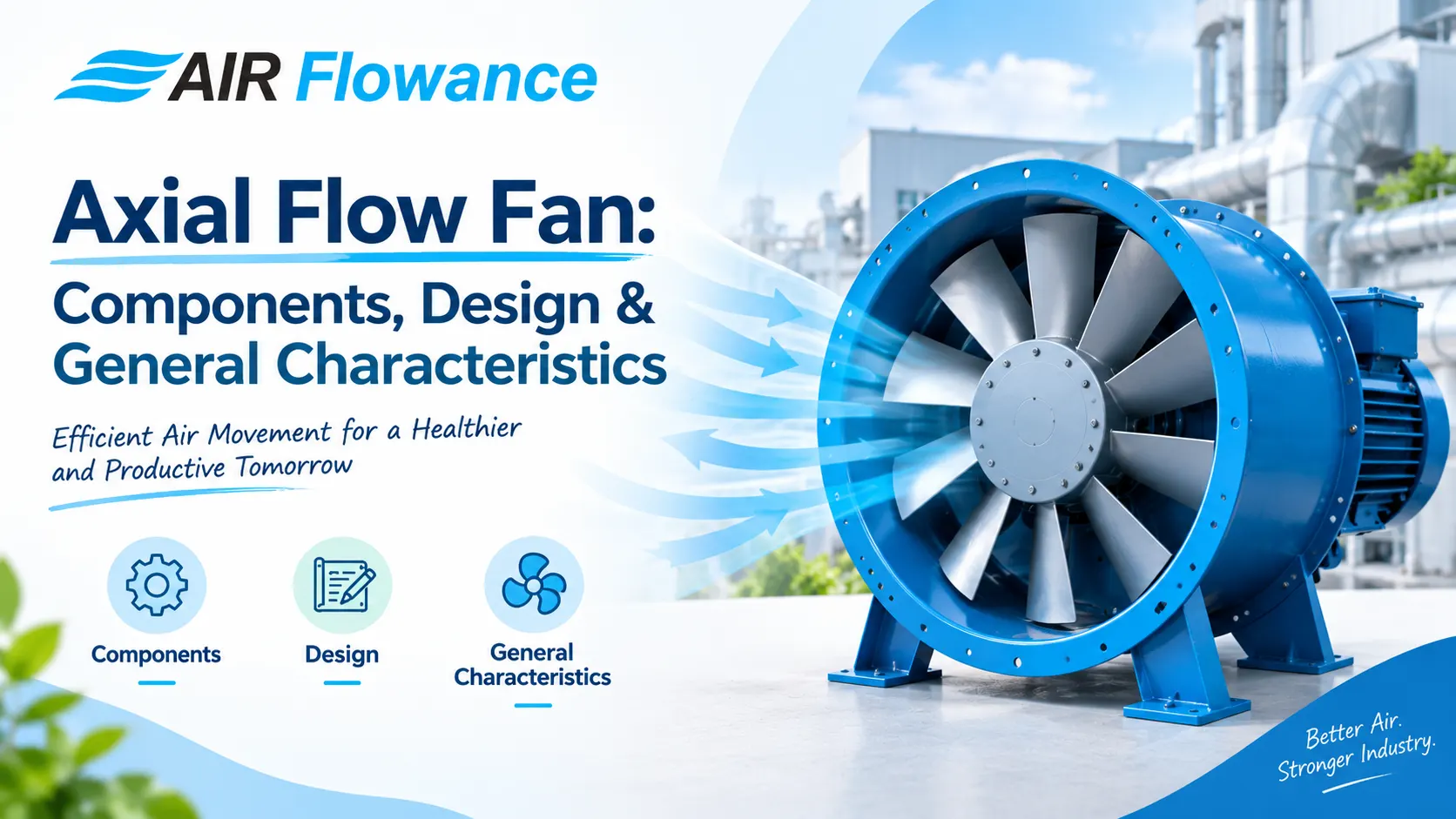
An axial flow fan is a widely used air-moving device designed to move large volumes of air along the same direction as the rotating shaft. These fans are commonly found in industrial ventilation, cooling, air circulation, exhaust systems, and various process applications. Air Flowance System provides industrial air movement and ventilation solutions designed around the requirements of different applications. Our company understands that fan selection depends on factors such as airflow capacity, pressure requirements, operating temperature, installation arrangement, and working environment. A properly selected axial fan can provide consistent air movement while supporting efficient industrial operations.
What Is an Axial Flow Fan?
An axial flow fan moves air parallel to the axis of its rotating shaft. When the fan blades rotate, they generate pressure that pushes air forward through the fan assembly. Unlike centrifugal fans, which change the direction of airflow, an axial fan generally maintains airflow in a straight path.
Because of this operating principle, axial fans are particularly useful when high airflow is required at relatively low to moderate pressure. They can be installed in ducts, walls, roofs, ventilation openings, cooling systems, and industrial exhaust arrangements.
Main Components of an Axial Flow Fan
The construction of an axial flow fan consists of several important components. Each part contributes to the overall performance and reliability of the equipment.
- Fan Blades: Fan blades are one of the most important parts of the system. Their shape, size, angle, and number influence airflow, pressure, noise, and energy consumption.
- Motor: The motor supplies the mechanical power required to rotate the fan blades. Motor selection depends on airflow requirements, operating speed, load, and the expected working environment.
- Fan Hub: The hub connects the blades to the rotating shaft. It transfers the motor’s rotational force to the blades and helps maintain the required blade position.
- Shaft: The shaft transfers rotational motion from the motor to the fan assembly. Its dimensions and material are selected according to the required torque, speed, and operating conditions.
- Casing: The casing surrounds the fan assembly and helps guide airflow through the unit. It also provides mechanical protection to internal components.
- Bearings: Bearings support rotating components and help reduce friction during operation. Good-quality bearings can contribute to smooth rotation, reduced vibration, and longer service life.
Design Considerations for an Axial Fan
Designing an axial flow fan requires careful consideration of the application’s operating conditions. Simply selecting a fan based on size may not provide the desired performance.
- Airflow Requirement: Airflow is generally measured in cubic metres per hour or similar units. The required airflow depends on the size of the area, ventilation requirements, heat generation, and process conditions.
- Pressure Requirement: An axial fan is generally selected for applications where high airflow is more important than very high pressure.
- Blade Design: Blade geometry directly affects fan performance. Blade pitch and profile can be selected according to the required airflow and pressure characteristics.
- Operating Environment: Temperature, humidity, dust, corrosive gases, and other environmental conditions can influence fan construction.
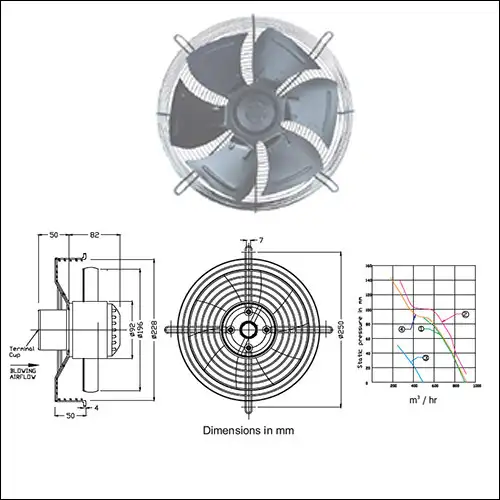
Characteristics of Axial Flow Fans
An axial flow fan has several characteristics that make it suitable for industrial air movement applications.
- High Air Volume: One of the major advantages of an axial fan is its ability to move large quantities of air. This makes it suitable for ventilation, cooling, and general air circulation.
- Compact Construction: Axial fans can provide substantial airflow without requiring the large footprint associated with some other types of air-moving equipment.
- Direct Airflow: The air generally travels along the axis of the fan, creating a straightforward airflow path. This characteristic makes axial fans useful for applications where air needs to move directly through a wall, duct, or ventilation opening.
- Easy Maintenance: The relatively simple construction of an axial fan can make routine inspection and maintenance more convenient.
- Flexible Applications: Axial fans can be used in factories, warehouses, workshops, commercial buildings, cooling systems, exhaust arrangements, and process ventilation applications.
Applications of Axial Flow Fans
Axial flow fans are commonly used for industrial ventilation, equipment cooling, warehouse air circulation, exhaust systems, agricultural facilities, manufacturing plants, and process cooling. They can also be used where large volumes of air need to be moved continuously through a relatively low-resistance system. Air Flowance System can offer air movement solutions for different industrial requirements. By considering the application’s airflow, pressure, temperature, installation arrangement, and operating environment, the appropriate fan configuration can be selected.
An axial flow fan is a practical and efficient solution for moving large volumes of air in a straight direction. Its major components—including blades, motor, hub, shaft, casing, and bearings—work together to provide consistent air movement. Proper design and selection are important for achieving the expected airflow, efficiency, and service life.
Air Flowance System aims to offer reliable fan solutions based on actual application requirements. Whether the requirement involves ventilation, cooling, exhaust, or general air circulation, understanding the components and characteristics of an axial fan helps industries make a more informed equipment selection.