
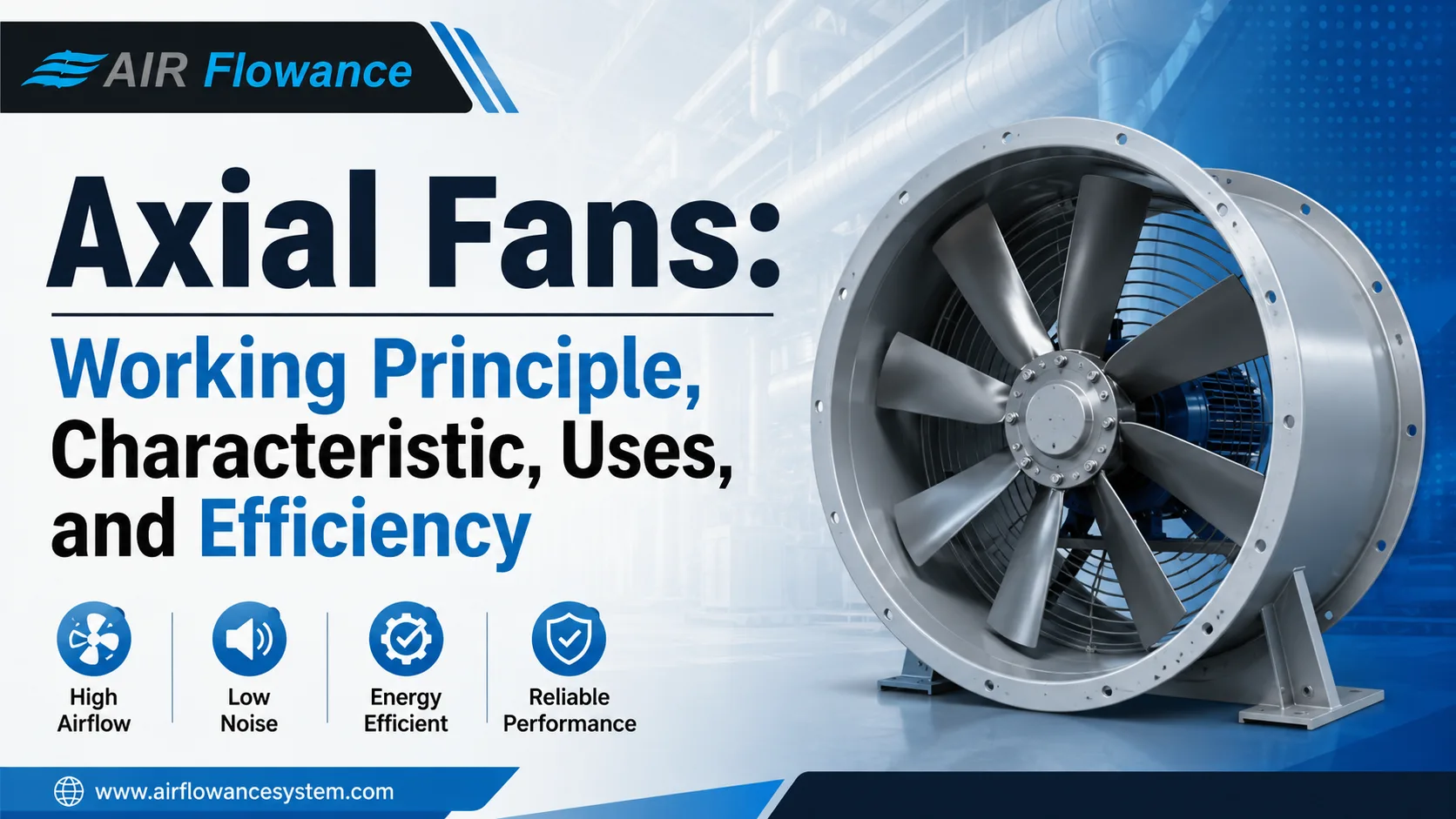
When it comes to moving large volumes of air efficiently, axial fans are one of the most commonly used ventilation solutions. They are designed to move air in a direction parallel to the rotating shaft, making them suitable for applications where high airflow and effective ventilation are required. The simple construction and practical working design of an axial fan make it useful for many different environments. Depending on the application, axial flow fans can be selected in different sizes, blade designs, speeds, and capacities. Air Flowance System offers reliable fan solutions for industrial and commercial ventilation requirements.
What Is an Axial Fan?
An Axial fan is a mechanical device used to move air or gas along the axis of its rotating blades. Unlike centrifugal fans, which change the direction of airflow, an axial fan pushes air straight through the fan. This makes it particularly useful when a large quantity of air needs to be moved over a relatively short distance. Air Flowance System offers axial fan solutions designed to support effective ventilation, cooling, and air circulation across different industrial and commercial applications.
Working Principle of Axial Fans
The working principle of axial fans is quite straightforward. Electrical energy is supplied to the motor, which rotates the fan blades through a shaft or direct-drive arrangement. As the blades rotate, they create a pressure difference between the inlet and outlet sides of the fan.
Air enters through the inlet and passes across the rotating blades. The aerodynamic shape of the blades generates an increase in air velocity, pushing the air forward along the same axis as the shaft. The moving air then exits from the other side of the fan. The performance of a fan axial system depends on several factors, including blade angle, blade shape, rotational speed, motor capacity, fan diameter, air density, and system resistance.
Characteristics of Axial Fans
Several unique features make axial fans one of the most widely used ventilation solutions across industries.
High Airflow Capacity
An axial fan is capable of moving large volumes of air quickly, making it ideal for general ventilation applications.
Energy Efficiency
Modern axial flow fans are designed with aerodynamic blades that reduce energy consumption while maintaining excellent airflow performance.
Compact Design
Compared to many other ventilation systems, axial fans have a lightweight and compact construction, making installation easier even in limited spaces.
Low Maintenance
With fewer moving components, an axial fan requires minimal maintenance and offers reliable long-term operation.
Quiet Operation
Advanced blade designs help reduce vibration and operational noise, making axial HVAC fans suitable for commercial buildings, offices, and healthcare facilities.
Types of Axial Fans
Different applications require different fan configurations. Common types include:
1. Tube Axial Fans
These fans are installed inside cylindrical housings and are commonly used for general ventilation in factories and warehouses.
2. Vane Axial Fans
Equipped with guide vanes, these axial flow fans provide improved efficiency and higher pressure compared to standard tube axial fans.
3. Propeller Fans
Designed for free-air movement, propeller-type axial fans are ideal for cooling and exhaust applications where low resistance exists.
4. Axial HVAC Fans
Axial HVAC fans are specifically designed for heating, ventilation, and air conditioning systems. They provide consistent airflow while maintaining energy efficiency in commercial and industrial buildings.
Uses of Axial Fans
The versatility of axial fans makes them suitable for numerous industries and applications.
Common uses include:
- Factory ventilation
- Warehouse air circulation
- HVAC systems
- Cooling towers
- Heat exchangers
- Data centers
- Parking garages
- Greenhouses
- Agricultural buildings
Because they efficiently move large quantities of air, axial HVAC fans are widely used in modern climate control systems.
Advantages of Axial Fans
Installing an axial fan offers several operational benefits.
1. Improved Ventilation
The fan continuously supplies fresh air while removing heat, smoke, and airborne contaminants from indoor environments.
2. Better Cooling Performance
Axial flow fans help regulate temperatures around machinery, equipment, and production processes, preventing overheating.
3. Reduced Energy Costs
Due to their efficient blade design, modern axial fans consume less electricity while delivering excellent airflow.
4. Easy Installation
Their lightweight construction allows quick installation in walls, ceilings, ducts, and ventilation openings.
5. Reliable Performance
Designed for continuous operation, axial HVAC fans provide dependable airflow with minimal maintenance requirements.
Why Choose Air Flowance System?
Choosing the right ventilation equipment can make a noticeable difference in the performance of an industrial or commercial air circulation system. Air Flowance System offers axial fan solutions designed around practical ventilation requirements. Our company focuses on providing products suitable for different airflow and cooling applications. Customers can discuss their requirements and select a suitable fan based on airflow volume, installation conditions, operating environment, and application needs.
Axial fans are simple yet highly useful ventilation devices capable of moving large quantities of air efficiently. Their straight-through airflow design, compact construction, versatile applications, and relatively easy maintenance make them suitable for many industrial and commercial environments.
From factory ventilation and warehouse cooling to machinery cooling and HVAC applications, an axial fan can help maintain effective air circulation. Understanding the working principle, characteristics, uses, and efficiency of axial flow fans makes it easier to choose the right solution for a particular application. With proper selection and installation, these fans can offer reliable performance and efficient air movement.