
Air Flowance System provides practical and efficient air pollution control solutions for industries where dust, chips, and other airborne particles are generated during production. A dust collector is one of the commonly used systems for separating dust particles from an industrial air stream. Its simple construction, low maintenance requirements, and ability to handle large volumes of dusty air make it suitable for many industrial applications.
A cyclone system does not depend on complex moving parts for primary dust separation. Instead, it uses centrifugal force to separate heavier particles from the air. This makes the cyclone dust collection system useful as a primary dust separation unit or as part of a larger air pollution control arrangement.
How Does a Cyclone Dust Collector Work?
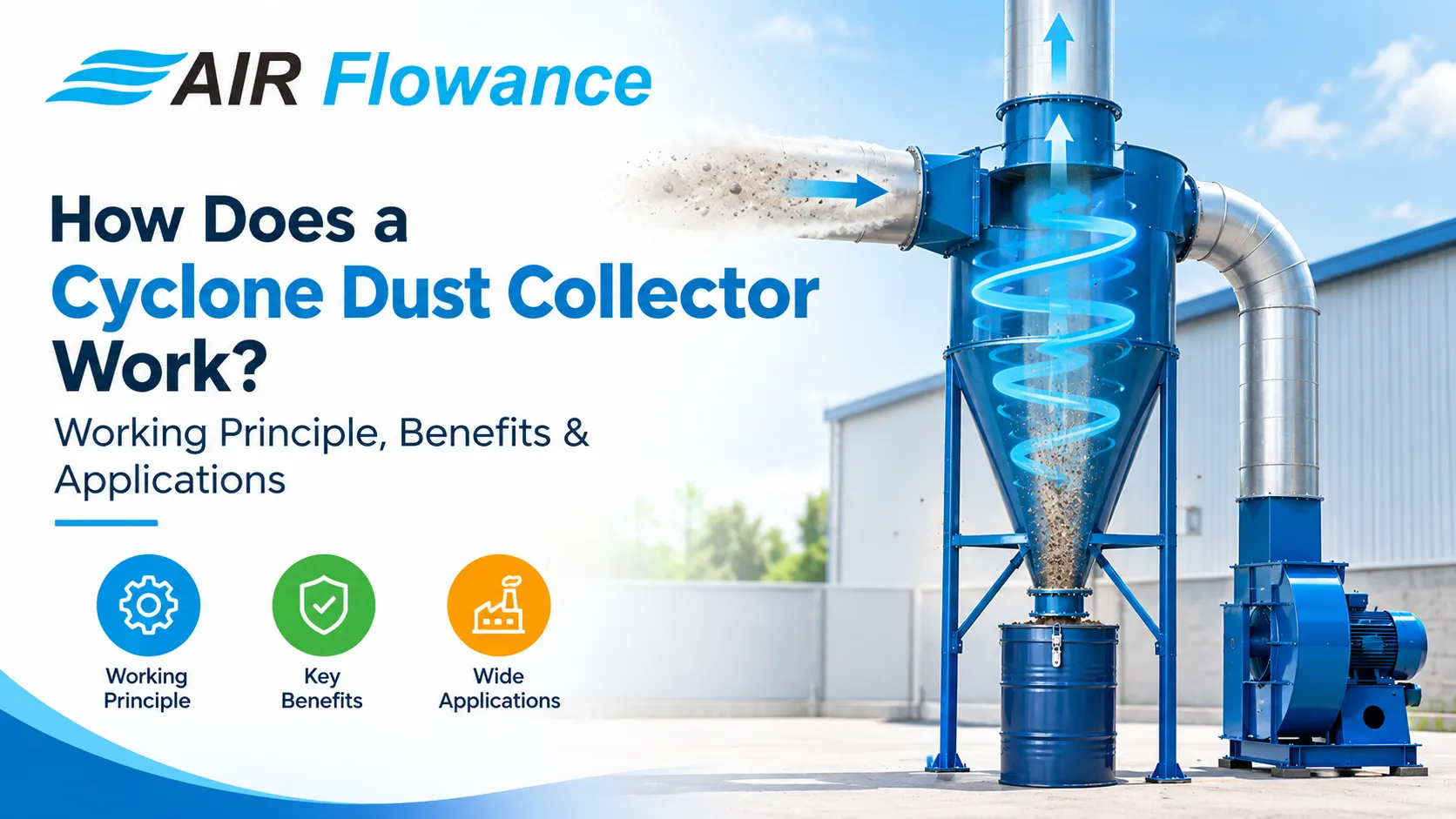
The working principle of a cyclone dust collector is based on centrifugal force. Dust-laden air enters the collector through an inlet positioned tangentially to the cylindrical body. As the air enters at high velocity, it starts moving in a circular or spiral path inside the chamber.
This swirling movement creates centrifugal force that pushes heavier dust particles toward the outer wall of the cyclone. As the particles lose their upward air support, gravity causes them to move downward into the collection hopper. The performance of a cyclone depends on factors such as air velocity, particle size, cyclone dimensions, pressure drop, and the properties of the material being collected.
How Does a Dust Collector Work?
A dust collector generally works by capturing contaminated air from a production area or process and separating dust particles from the air. Different types of dust collectors use different separation methods, including filtration, centrifugal force, electrostatic attraction, or wet scrubbing.
The dusty air enters the cyclone, rotates inside the chamber, and separates heavier particles from the air. The collected material falls into the hopper, while cleaner air leaves through the outlet. For applications producing very fine dust, a cyclone may be combined with a bag filter, cartridge filter, or another filtration unit.
Working Stages of a Cyclone Dust Separator
Dust-Laden Air Enters
The industrial air containing dust particles enters the cyclone through the inlet. The inlet design helps create the required rotational movement inside the chamber.
Air Starts Swirling
The incoming air follows a downward spiral along the inner wall of the cyclone. This creates centrifugal force and separates particles according to their mass and aerodynamic behavior.
Dust Moves Toward the Wall
Heavier dust particles are forced toward the outer wall because of centrifugal action. Once they reach the wall, their velocity decreases and they begin moving downward.
Dust Collects in the Hopper
The separated material falls into the lower hopper or collection section. This collected dust can then be removed periodically or through an appropriate discharge arrangement.
Cleaner Air Leaves the Cyclone
After heavier particles are separated, the cleaner air changes direction and moves upward through the central outlet pipe. Depending on the application, it may then pass through an additional filter or be discharged through the exhaust system.
Benefits of a Cyclone Dust Collection System
Efficient Removal of Larger Dust Particles
A cyclone is particularly useful for separating relatively coarse and heavier particles from industrial air. It can reduce the dust load reaching downstream filtration equipment.
Simple and Durable Construction
A cyclone dust collector generally has a straightforward construction with fewer moving components. This can make the equipment suitable for demanding industrial environments.
Lower Maintenance Requirements
Because the primary separation process does not require filter bags or cartridges, routine maintenance can be simpler than systems that rely entirely on filtration.
Suitable for High-Dust Applications
Cyclone collectors can handle substantial quantities of dust and are often used where production processes generate continuous or heavy particulate loads.
Protects Downstream Filters
When installed before a fine filtration system, the cyclone can remove larger particles first. This may help reduce the dust burden on downstream filters and support more consistent filtration performance.
Applications of Cyclone Dust Collectors
Cyclone dust collectors are used across different industries where particulate matter needs to be separated from process air. Common applications include:
Woodworking Industry
Wood chips, sawdust, and larger particles generated during cutting, sanding, and machining can be collected using cyclone systems.
Cement and Construction Materials
Cyclones can be used for separating dust generated during material handling, crushing, grinding, and processing operations.
Food Processing
Processes involving grains, flour, spices, and other dry materials can generate airborne particles. Cyclone separation can help control larger dust particles within suitable process arrangements.
Metalworking
Grinding, polishing, and machining operations can generate chips and particulate matter. Cyclone systems may be used for primary separation in suitable applications.
Chemical and Pharmaceutical Industries
Certain dry processing operations produce particulate emissions that require controlled collection. Cyclones can be incorporated into dust-handling systems depending on the material characteristics and process requirements.
Agricultural and Grain Processing
Cyclone systems are commonly considered for grain handling, milling, cleaning, and other operations where relatively coarse agricultural dust is generated.
Why Choose an Air Flowance System?
Choosing the right dust collection equipment depends on airflow, dust characteristics, particle size, temperature, process conditions, and required filtration efficiency. Air Flowance System focuses on practical industrial air pollution control solutions and can offer cyclone-based dust collection arrangements designed around specific application requirements. A well-designed cyclone dust separator can provide reliable primary dust separation while supporting the performance of downstream filtration equipment.
A cyclone dust collector works by using centrifugal force and gravity to separate heavier dust particles from an air stream. Its simple operating principle, durable construction, and ability to handle high dust loads make it useful across woodworking, agriculture, food processing, metalworking, construction materials, and other industries.
For applications where larger particles need to be removed before fine filtration, a cyclone dust collection system can provide an efficient first stage of dust control. Air Flowance System offers suitable dust collection solutions based on the requirements of different industrial processes.