
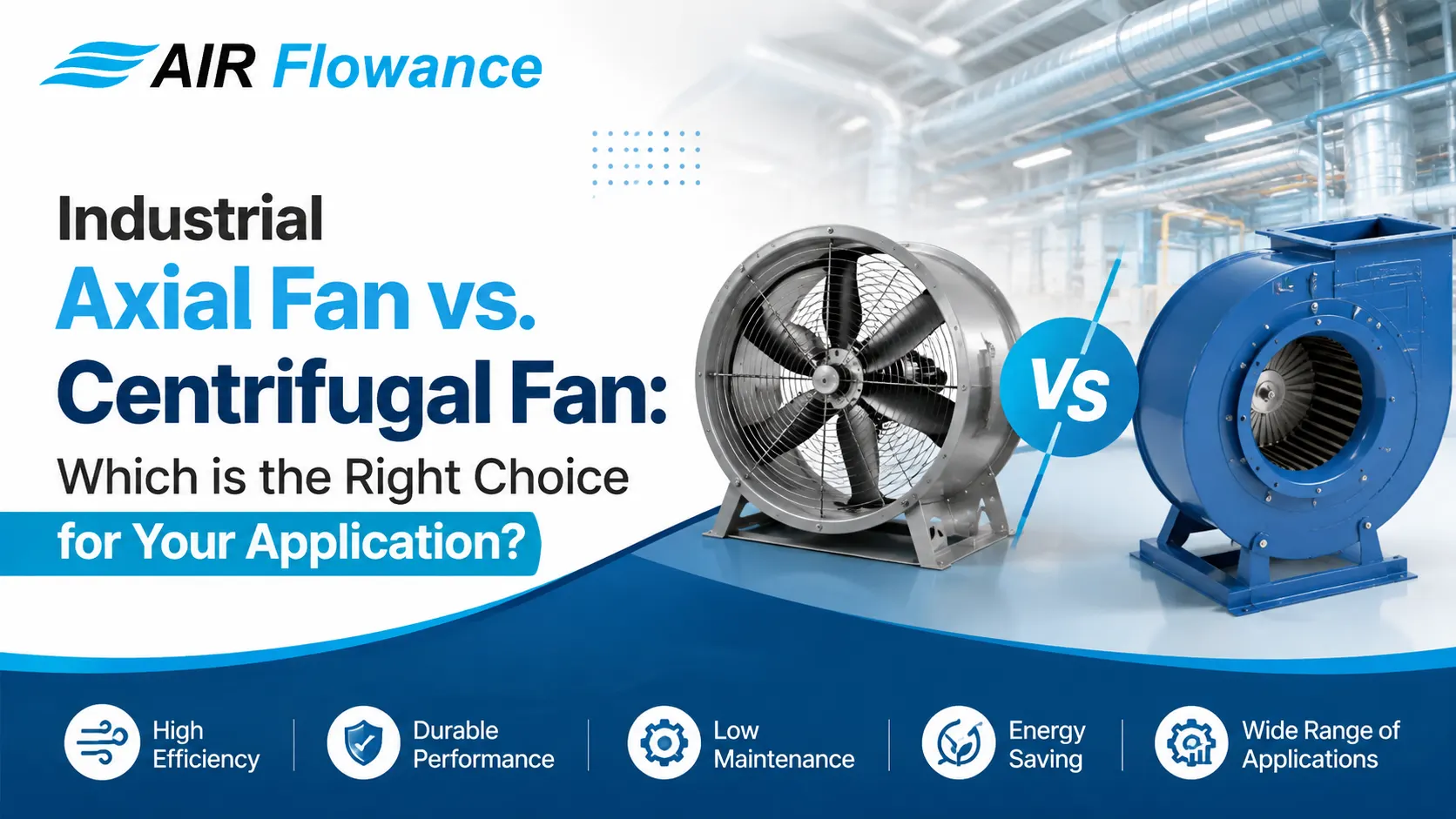
Choosing the right industrial fan is an important decision for maintaining effective ventilation, temperature control, air circulation, fume extraction, and process efficiency. Two of the most commonly used options are axial fans and centrifugal fans. Although both are designed to move air, their operating principles and applications are quite different. Understanding the difference between an axial fan vs centrifugal fan can help businesses select equipment that delivers the required airflow, pressure, and energy efficiency.
Air Flowance System understands that every industrial application has different ventilation requirements and can offer suitable air handling solutions based on specific airflow, pressure, and operating conditions. With the right fan selection, businesses can achieve improved ventilation performance, better energy efficiency, and reliable industrial operation.
Difference Between Axial and Centrifugal Fans
The primary difference between these fans lies in the direction of airflow. An axial fan moves air parallel to the axis of rotation. It pulls air in and pushes it out in a straight line, making it suitable for applications where a large quantity of air needs to be moved quickly.
A centrifugal fan, on the other hand, changes the direction of the air. Air enters near the center of the rotating impeller and is pushed outward at a right angle before being discharged through the fan housing. This design allows the fan to develop higher pressure.
When comparing axial vs centrifugal, the selection usually depends on airflow volume, static pressure, duct resistance, available space, noise requirements, and the type of air being handled. Both designs have valuable advantages when selected for the right operating conditions.
What Is an Axial Fan?
An axial flow fan consists of blades that rotate around a central axis, similar to a propeller. The blades create airflow in the same direction as the shaft. These fans are widely used where high airflow is required and system resistance is relatively low.The compact design can also make it suitable for wall-mounted and inline ventilation systems.
However, axial fans are generally less effective when the system includes long ducting, filters, bends, dampers, or other components that create significant resistance.
What Is a Centrifugal Fan?
A centrifugal fan is an industrial air-moving device designed to generate airflow and pressure through a rotating impeller. Air enters the center of the fan and is accelerated outward by centrifugal force. The air then passes through a scroll-shaped housing and exits at an angle to the incoming airflow.
The design makes centrifugal fans highly suitable for applications that involve greater resistance or pressure requirements. They can handle ducted systems more effectively than many axial fan designs.
Axial Fan vs Centrifugal Fan
| Point | Axial Fan | Centrifugal Fan |
|---|---|---|
| Airflow Direction | Moves air straight, parallel to the shaft. | Draws air in and pushes it outward at approximately 90°. |
| Air Volume | Best for moving a high volume of air quickly. | Provides more controlled airflow, especially in ducted systems. |
| Pressure | Suitable for low-pressure and low-resistance applications. | Generates higher pressure to overcome ducts, filters, and bends. |
| Design & Size | Generally compact and simpler in design. | Usually larger due to the impeller and scroll housing. |
| Applications | Used for general ventilation, cooling, and open-area exhaust. | Used for dust collection, fume extraction, HVAC, and ducted systems. |
Centrifugal vs Axial Fan: Handling Different Types of Air
Another important consideration in the centrifugal vs axial fan comparison is the type of air or material being moved.
- Centrifugal fans are available with different impeller designs for clean air, dusty air, fumes, smoke, and other industrial conditions. Certain models can handle particles and contaminants more effectively.
- Axial fans are commonly used for clean-air applications and general ventilation, although specially designed axial fans are also available for demanding environments.
Which Fan Is Right for Your Application?
There is no single answer that applies to every facility. The best choice depends on the requirements of your ventilation or process system.
Choose an axial fan when you need:
- High airflow volume
- Low system resistance
- Compact installation
- General ventilation
- Direct and straight airflow
Choose a centrifugal fan when you need:
- Higher static pressure
- Ducted airflow
- Fume or dust extraction
- Air movement through filters
- Greater resistance handling
For businesses looking for reliable industrial ventilation solutions, Air Flowance System can offer suitable fan and air movement solutions based on specific application requirements. Proper fan selection can improve workplace ventilation, equipment performance, energy efficiency, and overall process reliability.
The axial fan vs centrifugal fan decision should always begin with a clear understanding of the application. Axial fans are excellent for moving large volumes of air where resistance is low, while centrifugal fans are the stronger choice for systems requiring higher pressure and controlled airflow through ductwork.
Rather than focusing only on the basic centrifugal vs axial fan comparison, consider the complete system. Air volume, pressure, duct design, temperature, contaminants, energy consumption, and installation conditions all influence performance. The right axial vs centrifugal selection can provide better ventilation efficiency, longer equipment life, and dependable industrial operation. By evaluating these factors carefully, businesses can choose a fan solution that truly matches their application and operational needs.